


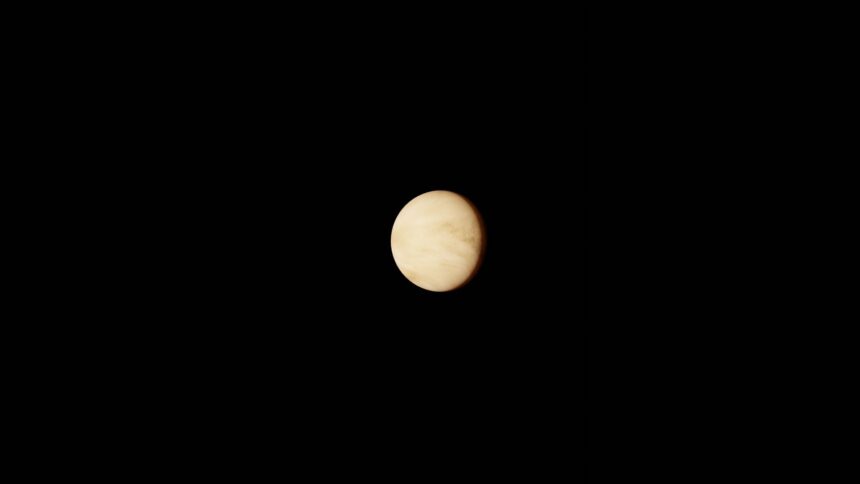
Of all the things the sky has done over North America in recent memory, this one is genuinely strange. At around 3:30 p.m. EDT today (exact timing varies by location; check a planetarium app for your coordinates), with the Sun still blazing high overhead, the Moon will slide in front of Venus and make a planet disappear. In broad daylight. In a matter of seconds (typically under a minute for an occultation of Venus).
Most people outside the astronomy community have no idea this is happening. And that, more than the science, is the part worth pausing on.
A lunar occultation of Venus in daytime is not the kind of thing you stumble into. You have to know to look for it, know where to look, and have a pair of binoculars or a small telescope handy to find Venus in the blue afternoon sky. But if you do — if you happen to be standing outside during the afternoon hours EDT today (check a planetarium app for precise local timing), you’ll watch a planet wink out of existence and come back. Here’s what makes it worth knowing.
The Moon covers Venus in just 29 seconds.s
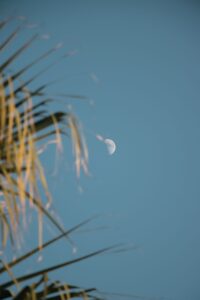
Venus is the brightest natural object in the night sky after the Moon itself. During today’s event, it shines at about magnitude -4, which sounds technical until you understand what it means practically: Venus is so bright it can be seen with the naked eye in full daylight, if you know exactly where to point your eyes.
But bright as it is, its disk measures somewhere between roughly 10 and 25 arcseconds across, depending on its current orbital position. The Moon, moving on its slow orbital path, needs just 29 seconds to cover that disk completely. One half-minute, and a planet is gone.
That speed is part of what makes an occultation feel surreal when you watch it through binoculars. There is no fading, no gradual dimming. Venus simply vanishes at the Moon’s leading edge, as cleanly as a light switched off.
It’s visible from nearly the entire contiguous United States
According to NASA JPL skywatching resources, today’s event is visible from a large portion of the contiguous United States, along with parts of Canada and portions of Central and South America. That is an unusually wide viewing footprint for an occultation. Many such events are visible only from narrow geographic corridors, which is part of why this one matters. If you’re anywhere in the lower 48 and the sky is clear, you have a chance.
The catch, always, is cloud cover. Even a thin overcast can scatter the light enough to make Venus impossible to locate in the afternoon glare. Clear skies are not negotiable for this one.
Why daytime occultations are different from nighttime ones
At night, a lunar occultation of a bright star or planet is spectacular and not especially hard to observe. The sky is dark, the Moon is a clear reference point, and the disappearing object stands out against the black. Daytime is another matter entirely.
The Sun floods the sky with scattered blue light, washing out everything except the most luminous objects. Venus, at magnitude -4, is bright enough to survive that wash, but only barely, and only to a practiced eye or an optical aid. The Moon itself, pale and half-lit, can be tricky to locate against the blue. This is the hidden challenge of daytime astronomy: the geometry is often more dramatic than nighttime events, but the viewing conditions require more preparation.
And here’s the strange part. The fact that it happens in daylight is exactly what makes it so memorable to people who do catch it. There is something deeply disorienting about watching a planet disappear against a blue afternoon sky, the Sun still up, birds still moving around, the ordinary world continuing below.
This is the first of three Venus occultations in 2026

Today’s event is the opening chapter of a short series. Several lunar occultations of Venus occur in 2026, which is relatively uncommon. The Moon and Venus align in this precise way only when their orbital paths converge at the right angle, a geometry that can cluster within a single year and then go quiet for years after.
That “after” matters here. The next lunar occultation of Venus visible from the contiguous United States won’t happen for several years. Three years away. If you miss today’s event, you aren’t waiting a few months for another chance. You’re waiting until a different administration is in office, until your children are three years older, until 2029 arrives,ves and most people have forgotten they ever meant to look up.
How to actually find Venus in the afternoon sky
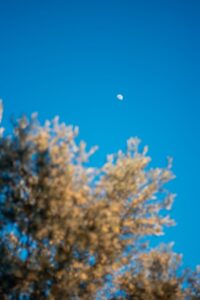
This is where most people get stuck. Finding Venus in daylight isn’t as hard as it sounds, but it does require a plan. The simplest approach: use a sky-charting app on your phone; several free options exist, including SkySafari and Stellarium, to locate the Moon first. The Moon, even in daylight, is easy to find once you know where to look.
Once you have the Moon, Venus will be close to its edge in the hour before ingress, the moment the planet disappears. Binoculars with a magnification of 7x or 10x are enough to see the event clearly. A small backyard telescope makes it sharper.
The naked eye is possible, but only if you have sharp vision and can position yourself so the Sun is blocked from your direct line of sight by a building or tree. Never look toward the Sun directly; the Moon will be well away from it during this event, but the habit of Sun-awareness is worth keeping.
The 15-arcsecond detail that explains everything
Venus’s disk (roughly 10, 25 arcseconds depending on its orbital position) is small by planetary standards, about one-thirtieth the diameter of the Moon as seen from Earth. It also changes. Venus goes through phases as the Moon does, cycling from a thin crescent to nearly full as it moves around the Sun. During some occultations, it’s a crescent. During others, it’s nearly fully illuminated. Today’s phase depends on where Venus sits in its current orbit.
This is something most people were never taught in school: that Venus has phases, visible with even a modest telescope, just like the Moon. The ancient Greeks and Romans saw Venus as a fixed, brilliant point of light in the evening and morning sky. Galileo Galilei was the first to observe its phases in 1610, and that discovery helped confirm the heliocentric model of the solar system. A 15-arcsecond disk, disappearing in 29 seconds behind the Moon, carries more history than it looks like.
What you’ll actually see, and why it’s worth remembering

The event lasts roughly an hour or more in total, from the moment Venus touches the Moon’s leading edge to the moment it reappears on the other side. The disappearance itself takes 29 seconds. The reappearance is similar, sharp, sudden, a planet blinking back into a blue sky.
People who have watched lunar occultations often describe the same thing afterward: how ordinary the world looks on either side of the moment, and how extraordinary the moment itself is. The lawn still needs mowing. The afternoon traffic is still moving on the street. And somewhere in the sky, a planet just hid behind the Moon at 3:30 on a Tuesday.
According to NASA JPL’s skywatching resources, events like this one are listed among the top skywatching highlights of 2026 specifically because daytime planetary occultations are accessible enough that a person with binoculars and an app can witness them, yet rare enough that most people go decades without seeing one.
The next chance is October 2029. The sky is clear today in a lot of places.
That’s the only argument that needs making.
Sources
This article was researched, written, and edited by our human editorial team. AI tools were used in a limited research-assistant capacity. All claims were independently verified.