


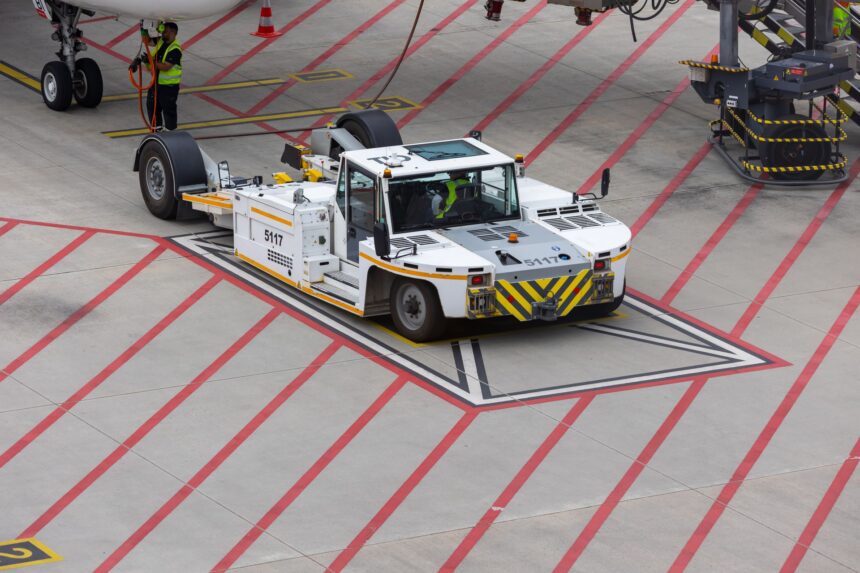
In 2026, Japan Airlines rolled out something the aviation industry had been promising for years and mostly failing to deliver: actual humanoid robots doing actual work on an actual tarmac. Not a demonstration. Not a trade-show prototype. Machines roughly human-sized, built by a humanoid robotics manufacturer, loading bags and moving cargo at a major Tokyo airport in Tokyo, one of the busiest airports on the planet. Haneda handles tens of millions of passengers a year, making it one of Asia’s busiest airports. One in five positions is unfilled.
That is not a minor staffing gap. That is a structural crack running through the foundation of how the airport functions. And here’s the part that matters beyond the spectacle of a robot hauling luggage: the trial is a genuine engineering test of whether a humanoid machine can slot into a workplace designed entirely around the dimensions and capabilities of a human body without anyone having to tear the workplace apart and rebuild it. Every conveyor belt, every cargo hold door, every baggage cart handle was built for hands with opposable thumbs attached to a five-foot-something biped. The robots have to work with that. They don’t get to redesign it. Japan’s labor problem is not a future concern.
It is a present-tense emergency. The country recorded millions of inbound tourists in early 2026, following a record number of visitors in all of 2025. More passengers. Fewer workers available to handle them. Japan’s working-age population is projected to fall 3by 1 percent by 2060, a number that sounds distant until you realize the workers who won’t exist in 2060 are already not being born. JAL’s partnership with a robotics technology firm represents a multi-year commitment.
The plan is not just to test whether the robots can carry bags without dropping them. If a safety verification milestone later in 2026 is cleared, JAL intends to expand the robots’ duties to cabin cleaning and ground support equipment operation. That is a meaningful escalation. Cabin cleaning requires working in confined spaces, navigating narrow aisles, hand-holding soft materials, and tasks that demand significantly more dexterity than moving a hard-sided suitcase on an open tarmac.
The trial is designed to answer a question that has never been answered at scale in a real operational setting: Can a humanoid robot be trusted around jet aircraft, fuel lines, and live baggage systems without becoming a liability? The engineering limitation that will define whether any of this works is not artificial intelligence. It is not sensor calibration. It is not the software stack. It is the battery. The robots currently operate for a limited number of hours before they need a recharge. On a shift where ground crews may work four to six continuous hours, that means a robot that needs to be rotated out and plugged in mid-operation. Someone has to manage that rotation. Someone has to ensure the charging station is in the right place at the right time.
The robot’s downtime creates its own coordination overhead. This is the honest version of where humanoid robotics actually is in 2026: impressive enough to put on the tarmac, not yet impressive enough to forget about. The battery constraint is not an embarrassing footnote. It is the central engineering challenge that separates a useful machine from a proof-of-concept that generates good press.
To be fair, two to three hours of productive operation per charge is nothing. In a high-volume ground handling operation, a robot that reliably handles baggage for two hours and then steps aside for a recharge may still be worth deploying, if the workflow can absorb the rhythm. That is what JAL is testing. Not whether the robot is perfect, but whether it is useful enough given its real limitations. The design philosophy behind deploying a humanoid form factor, rather than a purpose-built baggage conveyor or automated cart system, is worth examining because it is not obvious. A robotic arm bolted to a conveyor belt would handle bags faster, more reliably, and with a longer operational window than a biped with a two-hour battery.
Purpose-built logistics automation has existed for decades. Warehouses from Amazon to Alibaba use it. But none of that equipment works at a gate. The gate was built for humans.
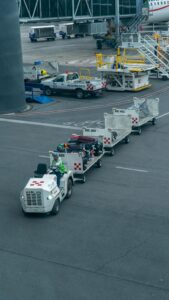
The cargo hold was built for humans. The ramp equipment was built for humans. Converting those environments to accommodate specialized industrial robots would require significant infrastructure investment and, in many cases, regulatory approval from aviation authorities. A humanoid robot sidesteps that problem. It fits in the same space. It reaches the same handles. It navigates the same pathways. The promise of the humanoid form factor is not that it is the most efficient machine for any given task; it almost certainly isn’t,
but that it is the most deployable machine across the widest range of existing human environments. Retrofit nothing. Just send in the robot. That is the hypothesis JAL is testing at Haneda. And it has implications well beyond aviation. Hospitals, hotels, logistics centers, retail warehouses, every labor-intensive industry that operates in buildings designed for people faces the same structural pressure that Japan’s airports face.
Aging workforces. Shrinking pipelines of younger workers willing to take physically demanding roles. Rising passenger and customer volumes are demanding more throughput from fewer hands. If JAL’s trial demonstrates that a humanoid robot can work reliably in a human-designed environment, take on expanding task complexity over time, and operate safely in close proximity to staff and passengers, the aviation industry will not be the only one watching the results. The multi-year trial will produce data on task completion rates, safety incidents, and operational integration that every warehouse operator and hospital administrator on earth has an interest in studying. The two-hour battery is the tell.
When that number reaches six hours, and it will, given the pace of battery development, the calculus changes entirely. What JAL is doing at Haneda right now is less about solving today’s staffing gap and more about stress-testing a technology that is going to be everywhere before most industries are ready for it. There is something almost understated about the way this trial launched. No fanfare, no countdown. A robot showed up to work at Haneda in May 2026, grabbed a bag, and got on with it. The airports that don’t pay attention to what happens next will spend a lot of time later wondering how they missed it. This article was researched, written, and edited by our human editorial team. AI tools were used in a limited research-assistant capacity. All claims were independently verified.