

In the province of Badajoz, in a dry corner of southwestern Spain called Extremadura, there is a landscape that looks, on the surface, like it has been quietly waiting. The hills roll. The scrub is pale. The ground holds its secrets well. And for most of recorded history, that is exactly what it did.
Then, in early 2026, archaeologists from the University of Gothenburg’s Maritime Encounters program documented six previously unknown Bronze Age mining sites near a town called Cabeza del Buey. What they found there didn’t just fill a gap in the map. It rewrote a story that most of us thought we already knew.
The swords and axes of Bronze Age Scandinavia, the weapons we associate with the northern warriors who came centuries before the Vikings, were not made from Scandinavian metal. The ore that forged them came from here. From this dry Spanish hillside. From mines that had been waiting underground for three thousand years.
Here’s the strange part: researchers had suspected this for years before anyone found the actual mines.
Lead isotope and chemical analyses of Scandinavian Bronze Age artifacts had already pointed to southwestern Spain as the most likely source of the metal. The chemistry told a story the geography couldn’t yet confirm. Southwestern Iberia’s ore signature appeared in swords, tools, and ornaments found thousands of miles to the north, in Denmark, in Sweden, in Norway. The match was too consistent to be a coincidence. But without the physical mines, it remained an educated suspicion.
Now the suspicion has an address.
The Ground Beneath Cabeza del Buey
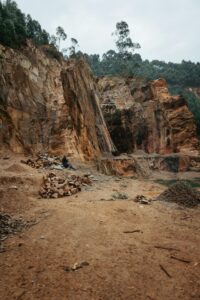
The sites documented near Cabeza del Buey contained copper and other metals, including lead and silver. These were not small operations. In one mine alone, archaeologists recovered dozens of grooved stone axes, the kind of heavy, shaped tools used to crush and process ore. Eighty of them. In a single site. That is not a village workshop. That is industrial-scale extraction for a world that hadn’t invented the word “industry” yet.
And according to Professor Johan Ling, who leads the Maritime Encounters program, the six documented sites may represent only a fraction of what remains to be found. He estimates that a significant number of prehistoric mines may still be undocumented in Extremadura and Andalusia alone. The landscape, in other words, is still keeping most of its secrets.
What this means takes a moment to absorb. Bronze Age Europe, the period roughly spanning 3300 to 800 BCE, was not a patchwork of isolated cultures each scratching out survival in their own territory. It was something far more sophisticated. Traders, sailors, and intermediaries were moving raw materials across the Atlantic coast of Europe on a scale that should, by rights, astonish us.
Think about the logistics. Copper ore dug from a hillside in Extremadura had to be smelted, cast, shaped, and then loaded onto ships, or more likely a chain of ships and overland routes, to travel somewhere in the neighborhood of 1,500 miles before it became a sword in Scandinavia. Someone organized that. Someone paid for it. Someone knew where they were going and why, three thousand years before there was a written word for any of it.
A Trade Network Built Before Rome
We tend to think of the ancient world in terms of what it lacked. No steel. No GPS. No paper currency. No standardized weights and measures are enforced by a central government. And yet the evidence from Cabeza del Buey suggests that the people of Bronze Age Europe had something we underestimate: a working knowledge of supply chains that functioned across an entire continent.
The metal that left Extremadura didn’t stay Spanish. It traveled north through what is now Portugal and France, passed through trading networks along the Atlantic seaboard, and eventually arrived in Scandinavian workshops where smiths who had never seen the Iberian peninsula shaped it into the objects we now find in museum cases labeled “Bronze Age Nordic.” The label is accurate about the craftsmanship. It is silent about the geography.
There is something quietly humbling in that. The people who built Stonehenge, who raised the megaliths of Brittany, who paddled along the Atlantic coast in boats we can barely reconstruct, they were connected to each other in ways that only the chemistry of ancient metal is finally confirming. The ore didn’t lie. The swords always knew where they came from.
Professor Ling’s estimate of 150 still-undocumented mines puts this find in an uncomfortable perspective. The six sites near Cabeza del Buey are not the end of the story. They are, if anything, an introduction. The region of Extremadura and Andalusia may hold a hundred and fifty more chapters buried in the same dry hillsides, each one potentially telling us something new about how ancient Europe actually worked, as opposed to how we have always assumed it worked.
What the Swords Were Trying to Tell Us

Source: Pixabay
Lead isotope analysis had already done its quiet work before the excavations confirmed anything. Researchers had measured the chemical signatures of Bronze Age artifacts across northern Europe and traced them, again and again, to the same southwestern corner of the Iberian peninsula. The chemistry was, in effect, a message in a bottle, sent three thousand years ago, decoded in a laboratory, pointing south toward a landscape no one had yet searched.
Finding the actual mines changes the status of that message. It moves the Atlantic Bronze Age trade network from “likely” to “confirmed.” It gives the chemical fingerprints an address. And it invites the obvious question: if we missed six mining operations this significant for this long, what else is still sitting under those hills?
Somewhere in Extremadura, there may be 150 more answers to that question. They have been there for three thousand years. They are not in a hurry.
This article was researched, written, and edited by our human editorial team. AI tools were used in a limited research-assistant capacity. All claims were independently verified.