

In spring 2026, a telescope in the mountains of southern Arizona finished a job five years in the making. The Dark Energy Spectroscopic Instrument DESI, to everyone who works with it completed the largest three-dimensional map of the universe ever produced. And buried in that map is a signal that has cosmologists reconsidering something they thought was settled: what dark energy actually does.
Dark energy is the force driving the universe apart. It makes up roughly 68 percent of everything that exists, yet no one has ever seen it, touched it, or explained it from first principles. For decades, the standard model of cosmology treated it as a constant, a fixed background pressure woven into the fabric of space, pushing galaxies outward at a steady, predictable rate. Einstein called it the cosmological constant. Most textbooks still do.
DESI’s data suggests the constant may not be constant.
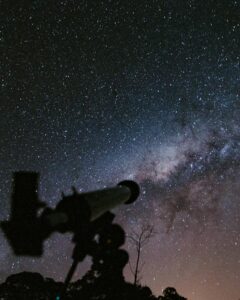
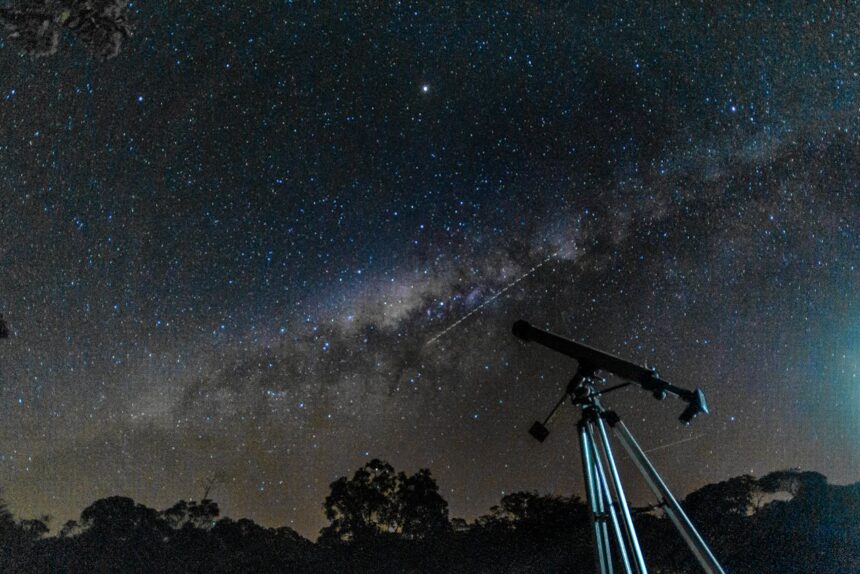
The instrument is mounted on the Mayall 4-meter Telescope at Kitt Peak National Observatory in Arizona. Over five years, its 5,000 robotic fiber-optic “eyes” swept the sky in systematic passes, locking onto galaxies and quasars and measuring how fast they’re moving away from us. The final tally: tens of millions of galaxies and quasars, plus millions of stars inside the Milky Way. The survey exceeded its original target by a substantial margin.. DESI beat it by 38 percent.
That alone would be a headline. But the more significant finding is what the data implies about dark energy’s behavior across cosmic time.
Here’s the strange part. When scientists measure how dark energy behaved in the early universe versus how it behaves now, the numbers don’t quite match. The discrepancy is subtle, not the kind of thing you’d see with the naked eye, but in cosmology, subtle discrepancies have a way of becoming revolutions. According to the DESI Collaboration, DESI’s survey has now measured cosmological data for more galaxies than all previous spectroscopic surveys combined. That kind of statistical weight means the signal isn’t noise.
What would it mean if dark energy is changing?
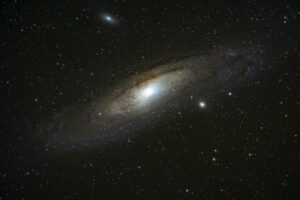
The short answer: the universe ends differently than we thought. The standard model predicts a “Big Freeze”, galaxies drifting apart until everything is cold, dark, and still, billions of years from now. If dark energy is strengthening over time, the outcome shifts toward a “Big Rip,” where the expansion accelerates until it tears apart galaxies, then solar systems, then atoms themselves. If dark energy is weakening, the universe might eventually stop expanding and collapse back on itself in a “Big Crunch.” Three possible endings. Three radically different futures. And right now, the data is pointing away from the one most people assumed.
The full analysis of DESI’s five-year dataset is expected in the coming years. The instrument is expected to continue observing beyond the initial five-year survey., collecting more data to sharpen the picture. Cosmologists have been careful not to declare the cosmological constant dead, one survey, even a record-breaking one, doesn’t overturn 30 years of framework. But the confidence intervals are tightening, and the tension in the data is real.
DESI’s 5,000 robotic eyes stared at the sky for five years. What they found doesn’t answer the question of how the universe ends. It just made the question harder to ignore.
This article was researched, written, and edited by our human editorial team. AI tools were used in a limited research-assistant capacity. All claims were independently verified.