

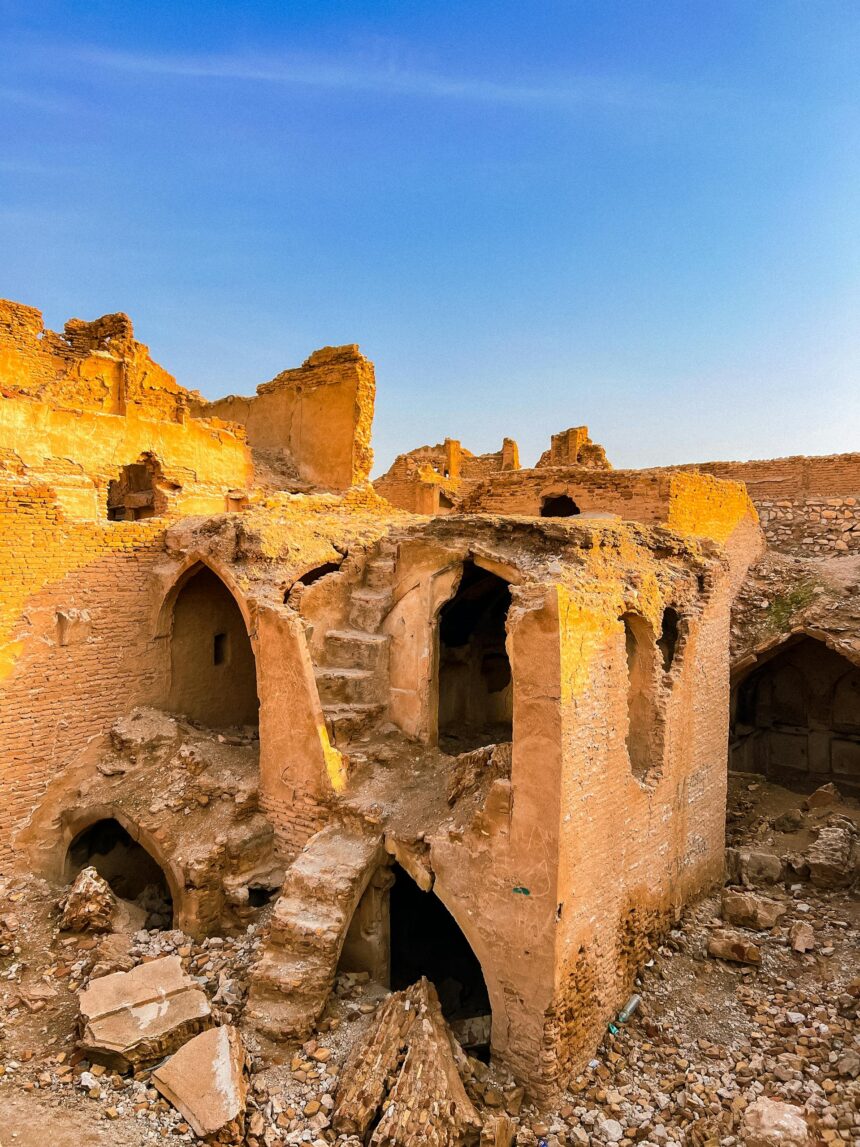
There is a low ridge of ancient brick in southern Iraq, There is a low ridge of ancient brick in southern Iraq, near the Iranian border, where walls still rise eight meters out of the sand., where walls still rise eight meters out of the sand. They stretch for kilometers. From the air, the outlines are unmistakable. On the ground, for most of the last half-century, you could not get near them without a weapon at your side.
The place is known locally by a site name in southern Iraq today. Two thousand years ago, it was Alexandria on the Tigris one of the cities Alexander the Great founded as he pushed east toward the edges of the known world, It later became known as Charax Spasinou, and for more than 550 years it functioned as one of antiquity’s great commercial crossroads, channeling Indian spices, Chinese silk, and rare exotic woods through Mesopotamian capitals like Seleucia and Ctesiphon and onward into the Roman world.
The city’s origins trace to Alexander’s eastern campaigns in the late 4th century BCE, with the site developing into a major settlement sometime around 325—300 BCE.. It later became known as Charax Spasinou, and for more than 550 years it functioned as one of antiquity’s great commercial crossroads, channeling Indian spices, Chinese silk, and rare exotic woods through Mesopotamian capitals like Seleucia and Ctesiphon and onward into the Roman world.
Then the river moved. And the city ceased to exist.
In early 2026, a professor at the University of Konstanz published findings confirming the site’s identity and scope, the result of years of painstaking survey work. Before any excavation was possible, his team covered an extensive surrounding landscape on foot, documenting surface finds: pottery fragments, architectural traces, the faint signatures of an urban grid that once held tens of thousands of people., documenting surface finds: pottery fragments, architectural traces, the faint signatures of an urban grid that once held tens of thousands of people.
They did all of it under armed guard. The Iran-Iraq War had turned the area into a military zone for years, and the site had been within a military zone during that conflict, making access impossible for researchers. The archaeologists who finally got close enough to document it properly were, in a sense, the first researchers to do so in modern memory.
And here’s the thing, the city didn’t fall to an army. No siege engines. No burning. Alexandria on the Tigris was not conquered or sacked in the dramatic way we tend to imagine ancient cities ending. It simply lost its water.
The Tigris shifted course westward over centuries, and sedimentation gradually pushed the Persian Gulf coastline southward, cutting the port off from navigable water. A city built on trade dies when the trade routes move. The walls stayed standing. The people did not.
The Port That Moved the Ancient World
It is worth pausing on what this city actually was. We tend to think of the ancient Silk Road as a land route, camel trains crossing deserts, mountain passes, the slow overland journey from China to Rome. But for much of the period between 300 BCE and 300 CE, the most efficient leg of that journey ran by water. Ships from India and beyond unloaded cargo at ports in the Persian Gulf region, and cities like Alexandria on the Tigris served as the transfer point where sea-borne goods became river-borne goods, headed north into the heart of Mesopotamia.
Silk moved through here. So did pepper, cardamom, teak, and whatever else the markets of Seleucia and Rome were willing to pay for. For five and a half centuries, this city sat at the hinge between two worlds. That is not a footnote in ancient trade history. That is the main story.
The Walls That Outlasted the Water
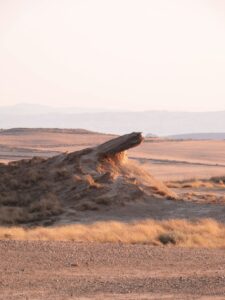
What makes Jebel Khayyaber haunting is that the evidence of its scale never really disappeared. The fortification walls, up to eight meters high in places, running for kilometers across the landscape, were always there, visible to anyone with access to aerial photography. The problem wasn’t finding the site. The problem was getting to it. War, then the aftermath of war, then political instability kept serious archaeological work at a distance for decades.
Professor Hauser’s team changed that by doing what archaeologists increasingly have to do in conflict-affected regions: they worked with what the surface offered, walked every meter they could reach, and built a picture of the city from what lay on top of the ground before ever putting a trowel into it. The 500-kilometer survey was the method, not just the logistics. It produced findings detailed enough to confirm the city’s identity, its approximate extent, and the story of its decline.
A city founded by one of history’s great conquerors, erased not by a greater conqueror but by geography, hidden for centuries beneath a military zone, and finally mapped by researchers on foot in an armed convoy. How strange it is, that this is the story archaeology sometimes looks like now.
The walls at Jebel Khayyaber are still standing. The excavation, presumably, is just beginning.
This article was researched, written, and edited by our human editorial team. AI tools were used in a limited research-assistant capacity. All claims were independently verified.