



In the early 1960s, a substantial share of all milk sold in the United States, according to estimates, suggests somewhere between 30 and 50 percent arrived at the front door before sunrise. Not at a grocery store. Not in a paper carton you grabbed off a shelf. At your door, in a glass bottle, left by a man who knew your name and how many children you had.
The industry that made this possible was, by several measures, worth more than some of the country’s most celebrated industrial giants, a comparison that becomes plausible when the full vertical infrastructure of dairy cooperatives is counted. That comparison sounds strange now. It didn’t then.
What happened next is one of the cleanest examples in American economic history of how an industry can be enormous, profitable, deeply embedded in daily life, and still collapse almost completely within a single decade.
The Numbers That Made the Milkman an Economic Force
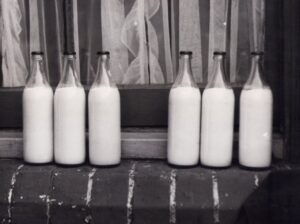
To understand how dramatic the fall was, you have to understand how large the business had grown.
By the early 1960s, home milk delivery was a vertically integrated machine. Dairy cooperatives owned the cows, the processing plants, the bottling operations, and the fleets of insulated trucks. Drivers, called route men, managed their own customer lists like small franchises, some of them personally servicing well over a hundred households on a single route. They extended informal credit. They remembered birthdays. They were, in many neighborhoods, more reliably present than the mailman.
The cooperatives that ran these operations were not small. National dairies and regional dairy conglomerates controlled distribution networks that stretched across entire states. Their collective market capitalization, combined with the physical infrastructure they owned, placed the industry in the same financial conversation as heavy manufacturing.
And yet, here is the strange part: the whole structure was already under pressure before most people inside it noticed.
The Supermarket Did What No Competitor Could
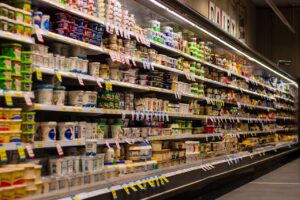
The milkman didn’t lose to another milkman. He lost to refrigeration and square footage.
Throughout the 1950s, supermarkets were expanding at a pace that reshaped American retail geography. By the late 1950s, the modern supermarket format, large, well-lit, stocked with dozens of product categories, was becoming the default grocery experience for middle-class American families. And supermarkets needed anchor products to pull customers in every week. Milk was the perfect anchor: perishable, needed constantly, and cheap enough to price aggressively.
The economics were brutal for the dairy routes. A supermarket could sell a gallon of milk for less than a route man could deliver it, because the supermarket absorbed no delivery labor cost and could negotiate volume pricing directly with processors.
The customer still had to drive to the store. But by the early 1960s, Americans were buying cars at record rates, and a weekly trip to the supermarket, where you could also buy bread, cereal, and everything else, was simply more efficient than keeping a delivery account.
Price was the blade. Convenience was the handle.
Route men watched their customer lists shrink by attrition rather than cancellation. Customers didn’t dramatically end their service. They just didn’t renew. They’d cancel after a vacation, and not restart. A new neighbor would move in and never set up an account at all.
The Cardboard Carton Finished the Job
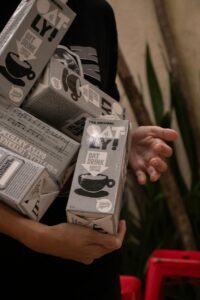
There was a second technological shift accelerating the collapse, and it came from an unexpected direction: packaging.
Glass milk bottles had always been a logistical burden. They had to be cleaned, sterilized, and returned, a reverse supply chain that added cost and complexity to every route. The waxed cardboard milk carton, which had existed in limited form since the 1930s, became commercially dominant in the 1960s as manufacturing costs fell and consumer acceptance rose. Cartons were disposable.
They didn’t have to come back. They could sit on a supermarket shelf without the infrastructure of a bottle return system.
For home delivery, this was nearly fatal. The glass bottle was part of the ritual, the satisfying clink on the porch step, the cream settled at the top. It was also, quietly, a tether: you needed the route man to come back and collect what he’d left. The carton severed that tether. Milk became just another package. And packages belong on shelves.
By the mid-1960s, the trend lines were unambiguous. Route coverage was contracting. Major dairy companies were quietly shifting capital from home delivery infrastructure into retail processing capacity. The cooperative model that had sustained the route system, where drivers had meaningful economic stakes in their customer relationships, was being restructured to cut costs.
A Decade to Dismantle a System That Took Fifty Years to Build
The route delivery system hadn’t appeared overnight. It took roughly fifty years to build, starting in the late 1800s when cities like New York and Chicago grew large enough that farmers couldn’t just knock on doors anymore. So they built distribution networks, the same way those cities built water pipes and streetcar lines. Essential. Not optional.
By 1970, home delivery was a fraction of what it had been ten years earlier. By the mid-1970s, it was basically gone from American suburbs. The cooperatives that survived pivoted entirely to retail. The ones that didn’t, didn’t survive.
Route men, the actual human infrastructure of the system, scattered into other delivery work, retail jobs, or early retirement. There was no formal acknowledgment of what had ended. No ceremony. The last bottles just stopped arriving.
Here’s the thing. The speed is what should stop you. This wasn’t a slow fade. It wasn’t twenty years of hand-wringing while consultants wrote reports. An industry capitalized like a major steel company, with trucks in every American city and customer relationships going back to the 1920s, was essentially gone in about eight years. Gone. If you grew up in the suburbs in the late 1960s, you probably watched it happen without knowing what you were watching.
The economic lesson isn’t about milk. It’s about what happens when a distribution model encounters a more efficient competitor at exactly the moment consumers have both the mobility and the storage capacity to switch. The milkman needed customers who couldn’t get to a store easily, who didn’t have reliable refrigerators, and who valued the relationship enough to pay a premium for it. By 1963 or so, most American households had stopped being that customer, they just hadn’t told the dairy yet.
The supermarket didn’t kill the milkman. It revealed that the milkman’s real product was convenience, and then it sold convenience cheaper.
Whether any business operating today on the assumption that customer loyalty outlasts price efficiency has taken that lesson seriously is worth asking.
This article was researched, written, and edited by our human editorial team. AI tools were used in a limited research-assistant capacity. All claims were independently verified.