

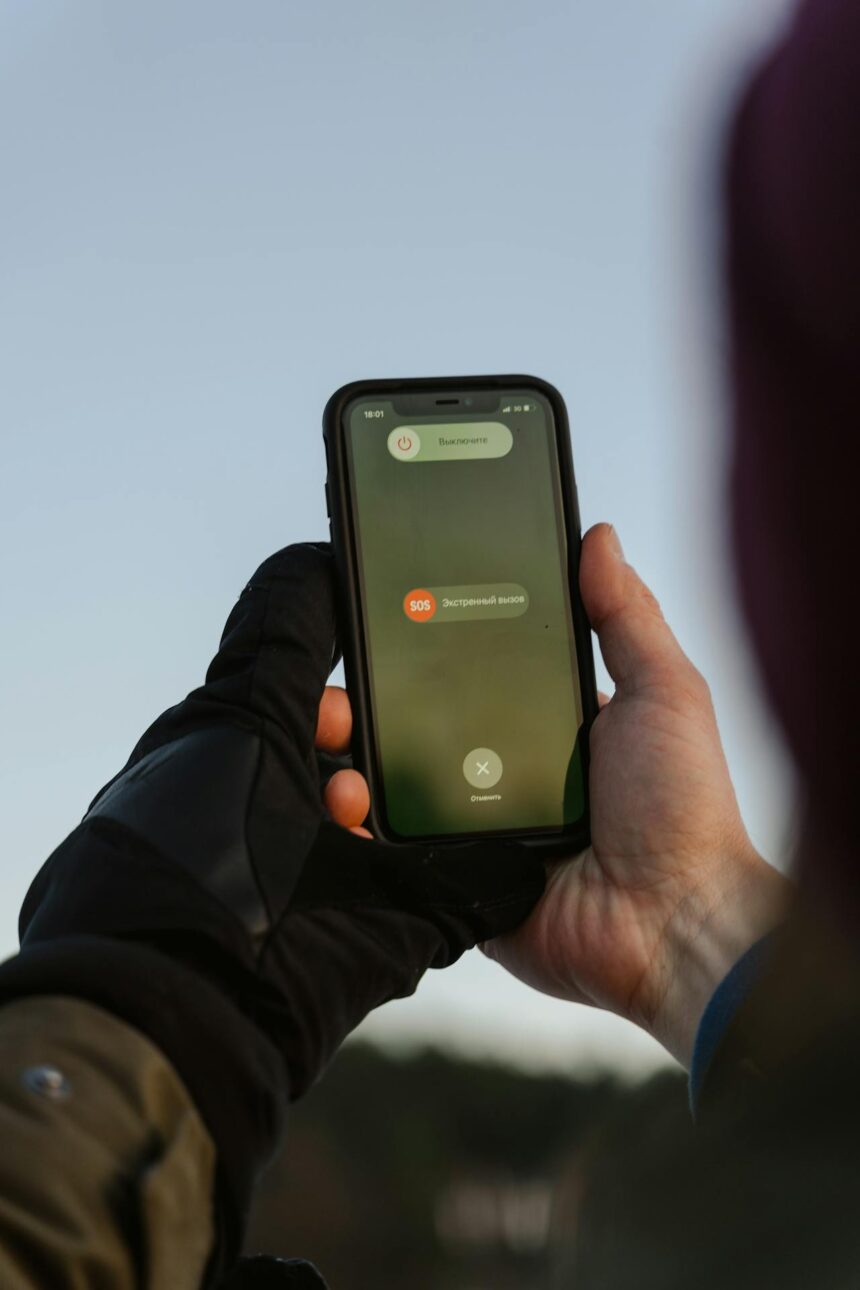
Pick up your phone right now. Look at the screen. It’s smooth, cold, and hard. Taps like glass. Reflects like glass. Every instinct you have says: glass.
It isn’t.
Or rather, it isn’t only glass and the part that makes it work, the part that keeps it from shattering when you drop it face-down on a tile floor, is something far stranger. It’s a material that behaves like a solid but flows like a liquid, a substance so far outside normal categories that the engineers who designed it had to invent new vocabulary to describe what it was doing.
Here’s the strange part: the stuff protecting your screen has more in common with a frozen river than with a window.
What Glass Actually Is

To understand why your phone screen isn’t quite glass, you have to understand what glass actually is, which turns out to be one of the weirder questions in materials science.
Glass isn’t a crystal. Crystals have atoms arranged in neat, repeating patterns, like tiles on a bathroom floor. Glass has atoms arranged randomly, like a pile of marbles someone dropped. Scientists call this an amorphous solid, which sounds technical but means something specific: the atoms froze in place before they could organize themselves. The result is a material that’s technically always in a slow, disordered state, not quite solid, not quite liquid, just… arrested.
Window glass, the kind in your house, is made mostly from silica, silicon dioxide, the same stuff as sand, melted down and cooled fast enough that the atoms can’t line up. It’s been made essentially the same way since ancient Rome. It’s cheap, clear, and reasonably hard. It also shatters in exactly the way you’d expect if you dropped it.
Your phone screen starts with the same basic idea but goes somewhere very different.
The Gorilla in the Room

The glass in most modern smartphones isn’t standard silica glass. It’s a specialized aluminosilicate glass, glass made with aluminum oxide mixed into the silicon structure, that’s been through a process called ion exchange. That process is the real story.
Here’s how it works. The glass gets dunked in a bath of molten potassium salt at around 400 degrees Celsius. The smaller sodium ions already sitting inside the glass get pushed out by larger potassium ions from the bath. Those bigger ions get crammed into spaces too tight for them. They can’t move. But they push outward against the surface constantly, and that pressure is what makes the glass hard to crack. Not the glass itself. The invisible mechanical stress is locked inside it.
It’s a bit like packing a suitcase so tightly that the sides bow outward. The zipper holds, but only because of the pressure. Release it and everything shifts.
The best-known brand associated with this technology is Corning’s Gorilla Glass, which has been widely adopted across the smartphone industry. It has been through multiple generations of reformulation since it was first commercially developed. But the underlying principle, chemically strengthened glass under compressive stress, is the same across most premium phone screens, regardless of what the manufacturer calls it.
And here’s what that means practically: when you drop your phone, the screen doesn’t shatter the way a window would. The compressive layer resists crack propagation. A crack has to fight its way through all that built-in pressure before it spreads. Sometimes it wins. Sometimes it doesn’t. But that’s why your screen might survive a three-foot drop onto concrete and fail spectacularly on a two-foot drop onto a specific corner; it’s not about height, it’s about whether the impact hits a compressed zone or finds a weak spot at the edge.
The Part That Really Isn’t Glass

But the glass layer is only half the story. What makes a smartphone screen a smartphone screen, responsive to your finger, capable of displaying 16 million colors, sensitive enough to distinguish a light tap from a swipe, involves layers that have nothing to do with glass at all.
Under the glass (or integrated into it, in some newer designs) is a touch-sensitive layer made from indium tin oxide or similar transparent conductive materials. This layer carries a small electrical charge across the entire surface. When your finger touches the screen, it disturbs that charge at a specific location. The phone detects the disturbance, calculates the coordinates, and responds. You perceive this as the screen reacting to your touch. What’s actually happening is closer to an electrical interruption than a physical press.
Below that is the display itself. In most modern phones, that means an OLED or LCD panel. OLED screens, each pixel lights itself. LCD screens shine a backlight through liquid crystals that open or close like tiny shutters. Neither is glass. Neither looks like anything you’d call a display if you saw it under a microscope.
The screen you see is the product of at least four or five distinct layers working together: the outer glass, the anti-reflective coating on top of it, the touch-sensing layer, the display panel, and often a polarizing filter somewhere in the stack. Take any one away, and the screen stops working. The glass is just the outermost, most visible, most touchable part.
Which is probably why we call the whole thing glass.
When It Breaks
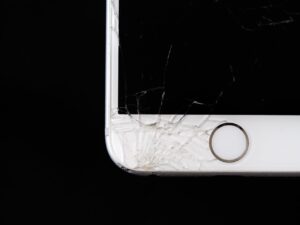
Here’s what actually happens when a phone screen cracks, because it clarifies everything above.
The chemically strengthened outer layer is under compressive stress, which resists cracks from forming. But the interior of the glass is under tensile stress, the equal and opposite force. When an impact is strong enough to push through the compressive layer and reach the tensile interior, the crack doesn’t stop. The tension that had been holding everything in balance releases at once, and the damage spreads faster than you can see it happen.
This is why screen cracks often spider outward from a single point. And it’s why a screen that looks intact after a drop might suddenly develop a spreading crack hours later, the compressive layer held, but the interior tension found a path. Given enough time, or a small second impact, it gives.
Screen protectors work by absorbing impact energy before it reaches the glass layer, essentially acting as a sacrificial layer. The tempered glass protectors you see sold everywhere are themselves chemically strengthened glass, designed to crack so yours doesn’t. That’s not marketing. That’s how physics works.
What’s Coming Next

Materials scientists have been working on screen materials that move beyond the glass-under-stress model entirely. Foldable phones already use polymer screens, essentially sophisticated plastics, that can bend without cracking. These have their own tradeoffs: they scratch more easily and don’t have the same optical clarity as glass under most conditions. But they’ve proven that a phone screen doesn’t have to be glass at all.
Some researchers have explored transparent ceramics, composite materials that combine glass and polymer layers, and even graphene-based coatings that could theoretically offer both flexibility and hardness simultaneously. Whether any of those become the next standard is an open question. But the trend is clear: the category called “phone screen” is going to keep moving away from anything your grandmother would recognize as glass.
In the meantime, the thing in your pocket is a five-layer stack of engineered materials, some of which don’t exist anywhere in nature, held together by chemistry and physics in ways that took decades to figure out.
It looks like glass. It acts like glass. It breaks like glass.
But what it actually is turns out to be a better question than most people think to ask, and the answer is considerably stranger than the word “glass” suggests.