


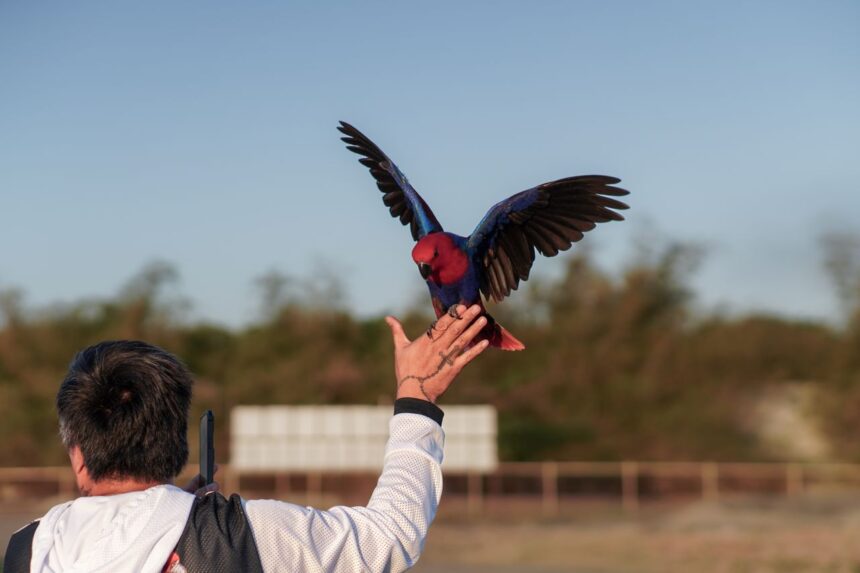
There is a moment every parrot owner knows. You walk into the kitchen, back turned, and your bird calls out something that sounds exactly like your name. Not a squawk. Not a random syllable. Your name. And you’ve always wondered, in the quietest part of your mind, whether it actually meant something.
As of April 2026, there’s real evidence it might.
A study published in PLOS One in April 2026 tracked vocalizations from hundreds of companion parrots and found that nearly half of them appeared to use names as labels for specific people or animals — not simply as ambient noise they had absorbed from their environment.
The research was led by a team including researchers from the University of Northern Colorado and a co-author from the University of Pittsburgh at Johnstown, and the findings sit quietly at the edge of what we thought we understood about animal language.
Here’s the part that stops you cold: these weren’t just birds repeating sounds they’d heard a thousand times. Among the parrots surveyed, nearly half produced hundreds of phrases that included names. Researchers identified a subset of recordings that appeared to show a parrot using a name as a label for a particular person or animal in context — the way you or I would say “Mom” when we want a specific person’s attention, not just when we’re practicing the word.
That is not mimicry. Or at least, it’s something more than mimicry.
What “Knowing a Name” Actually Means

The distinction matters more than it might seem at first. A parrot that mimics your name has learned to produce a sound. A parrot that uses your name as a label understands, on some level, that the sound refers to you specifically, that it summons you, identifies you, and connects to your presence in the room. The second thing is closer to what a toddler does when it points at a parent and says a name for the first time. It’s a referential act, not a performance.
Researchers have been circling this territory for years. Wild African savannah elephants have been documented calling to each other with name-like vocalizations that appear to be unique to each individual. Bottlenose dolphins do something similar with signature whistles, sounds that function as personal identifiers rather than species-wide calls.
Both findings turned heads in the animal cognition world when they emerged. What the PLOS One parrot study adds, if its figures hold, is the scale of it. Nearly half of the birds studied. That’s not a handful of exceptional animals in a lab. That’s a pattern across tens of millions of households.
And here’s the strange part: parrots weren’t supposed to be in this conversation. The naming behavior documented in elephants and dolphins emerged largely from field research on wild populations, animals with rich social lives, large brains, and evolutionary pressures that might reward complex vocal communication. Parrots in living rooms watching afternoon television were not the expected candidates for referential naming.
The Bird You Thought You Knew

Companion parrots are, by most estimates, among the most common pet birds in the United States. Owners have long reported behaviors that felt like more than trained response, birds that seemed to track family members by name, that reacted differently when a specific person entered the room, that appeared to use learned sounds with something that felt like intention. The scientific literature has generally been cautious about these reports. Anecdotes are easy to misread. People love their animals and project accordingly.
What Benedict and Dahlin did differently was gather data at scale. Rather than studying a small number of birds in controlled conditions, they collected survey responses and recordings from hundreds of parrot owners, then analyzed the vocalizations for evidence of referential name use.
It’s not a perfect methodology, there are real limits to what owner-reported data can establish, but 88 recordings showing apparent name labeling across hundreds of birds is a finding that earned its place in a peer-reviewed journal.
The DOI for the study is 10.1371/journal.pone.0346830.
What This Does and Doesn’t Prove
Science is careful for good reasons. The PLOS One study establishes that the behavior appears to exist. It does not establish that parrots understand names the way humans do, or that the cognitive process behind it is anything like what happens in a toddler’s brain. The gap between “uses a sound referentially” and “understands language” is large and not closed by this research.
But the finding does something important anyway. It puts companion parrots in the same category of inquiry as elephants and dolphins, animals whose communication systems we now treat as genuinely complex rather than reflexive. That’s a shift in how the question gets asked. Once you’re asking “what does my parrot understand” rather than “what has my parrot memorized,” the answers start looking different.
There’s also something quietly humbling about the scale. Half of 884 birds. Not one exceptional case, not a trained show animal, not a research parrot raised in special conditions. Ordinary companion birds in ordinary homes, doing something researchers had to look twice to believe.
My grandmother had a green-and-yellow parrot named Biscuit for about eleven years. He lived in the kitchen, near the window, and he called her by her first name, “Elsa, Elsa”, in a voice that sounded uncannily like my grandfather’s. She always said he knew the difference between calling her and calling anyone else. She was probably right. How strange it is to remember now, knowing there might have been something real behind it.
That’s the part this study can’t fully explain: what it’s like to be on the receiving end of a name from a bird. It’s small. It’s odd. And it turns out it may have meant exactly what it felt like it meant.
Sources
This article was researched, written, and edited by our human editorial team. AI tools were used in a limited research-assistant capacity. All claims were independently verified.