

In May 2026, Google quietly retired the Fitbit brand, a name that had been on wrists since 2007. Seven days later, it shipped a device that looks nothing like what Fitbit built its reputation on. No screen. No notifications. No glowing interface asking you to close your rings or congratulate you on your steps. Just a small oval of plastic and sensor glass, weighing just grams with its band, rated for water resistance, retailing at an accessible price point. Google calls it the Fitbit Air.
The design argument embedded in that device is blunter than anything in the press release. The smartwatch arms race longer battery life, sharper displays, more app integrations, always-on screens, may have been running in exactly the wrong direction. The Fitbit Air carries four sensor systems inside that small housing.
An optical heart rate sensor reads blood flow through the skin continuously. Red and infrared light emitters measure blood oxygen saturation, which clinicians call SpO2. An accelerometer and gyroscope track movement across every plane, not just steps, but sleep position, micro-movements during rest, and activity intensity. A skin temperature sensor logs baseline and deviation. None of that data shows up on the device itself.
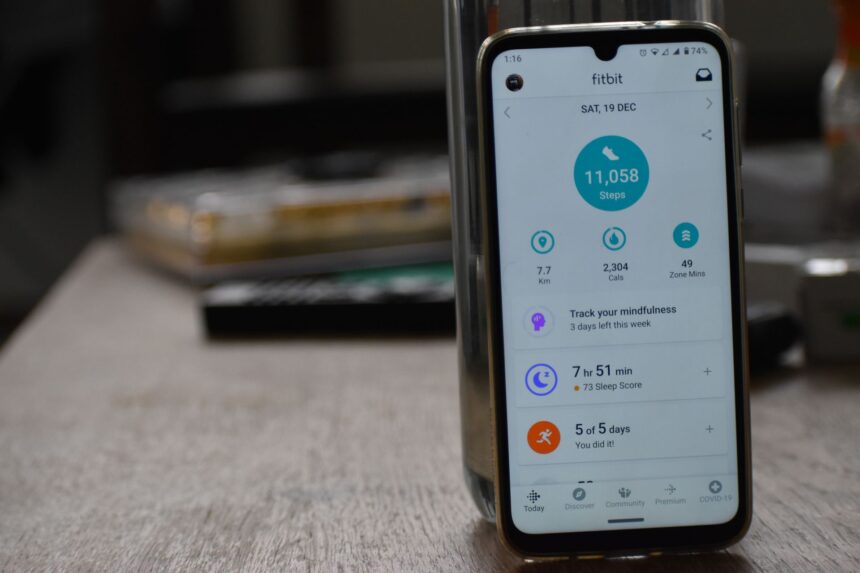
There is no screen to show it on. All of it flows to Google Health, the AI-powered platform that replaced the Fitbit app in May 2026. The phone does the display work. The wrist does the sensing work. Google’s argument is that those two jobs were always different, and we spent a decade pretending they weren’t. And here’s the strange part: most of the health data a continuous wearable collects is useless to you in real time. Your resting heart rate at 2:47 in the afternoon is not information you need to act on right now.
It’s a data point that becomes meaningful over days, weeks, and months, when a physician or an algorithm can compare it to your baseline and spot a trend. Putting it on a screen you glance at dozens of times a day doesn’t make you healthier.

It just makes you more aware of a number. The AFib detection capability is what makes the technical question genuinely interesting. Atrial fibrillation is an irregular heart rhythm that can go undetected for years and dramatically increases stroke risk. Detecting it traditionally required an EKG, electrodes, a clinical setting, and a cardiologist reading the output. The Fitbit Air doesn’t use electrodes. It uses photoplethysmography, or PPG, the same optical technique that gives any modern fitness tracker its heart rate reading. A green LED shines into the skin; a photodetector reads how much light bounces back.
Blood volume changes with each heartbeat, so the reflected light pulses in rhythm with the heart. By analyzing the timing and shape of those pulses with enough precision, the device can identify the irregular, chaotic beat pattern characteristic of AFib. The accuracy isn’t equivalent to a clinical EKG, and Google doesn’t claim it is. What PPG-based AFib detection does is flag. It says: something in this person’s rhythm warrants a closer look. For a condition that often has no symptoms and frequently goes undiagnosed for years, a flag is enormously useful.
The 3-axis gyroscope matters here too. Motion artifacts, the signal noise created by moving your arm, have historically been the enemy of accurate PPG readings. Better motion tracking means the device can subtract that noise more cleanly and improve the reliability of what it’s actually measuring.
The Fitbit Air is not the first screenless wearable, and Google is not the only company betting on the category. That growth reflects something real: consumers are starting to distinguish between health monitoring and smartphone extension. A smartwatch has always tried to do both. A screenless band chooses one. The tradeoff is obvious. You give up convenience. You can’t glance at a notification or check the time. If you want to know what your heart rate was during last night’s sleep, you open an app. For some users, that friction is unacceptable.
For others, and apparently for a growing slice of the market, the absence of a screen is the point. A device you forget you’re wearing is one that doesn’t compete with the rest of your attention. Google’s retirement of the Fitbit app brand is the more consequential move, in some ways. Fitbit built its user base on a specific identity, a step-count culture, a competitive leaderboard, and a decade of morning emails telling you how close you came to your goal.
Google Health is something different: a health data platform that positions itself as a longitudinal health record rather than a daily motivational tool. The brand transition signals that the audience Google is chasing isn’t the person who wants to win a challenge against their coworker.
It’s the person who wants their doctor to have better data at their next appointment. Whether a $99.99 device with no screen will find that audience at scale is a legitimate question. Fitbit built its name on making health tracking approachable. The Air makes it invisible. Those are different promises to different people, and not everyone will prefer the second one.
The 88% growth number suggests direction, not destination. What the Fitbit Air does settle, at least as a design statement, is the argument about what a wearable is actually for. The screen was never a healthy computer. The sensor array was. It just took a 12-gram pebble to make that obvious.
Source
This article was researched, written, and edited by our human editorial team. AI tools were used in a limited research-assistant capacity. All claims were independently verified.