



In early 2026, a study landed in a leading peer-reviewed medical journal that described something most retinal specialists had stopped expecting to see in their careers: a device that gave legally blind people their reading back. Not partially. Not theoretically. At home, in their kitchens, reading numbers and words with an eye that had gone dark.
The device is called PRIMA. It measures 2×2 millimeters and sits 30 micrometers thick, roughly the width of a single human hair. It is implanted beneath the retina in a surgical procedure, and it runs on light.
That last detail is the part worth sitting with. No battery. No external power source threaded into the skull. The chip is photovoltaic: it converts near-infrared light into electrical signals, which then stimulate the surviving cells in a retina that geographic atrophy has otherwise destroyed. The light comes from a pair of augmented-reality glasses the patient wears, which project a processed version of whatever they are looking at directly onto the implant. The chip converts that projection into neural impulses. The brain, remarkably, fills in the rest.
And here’s the strange part: the brain isn’t getting a perfect image. It’s getting a grid of electrical nudges from a 2-millimeter array of photodiodes. Yet patients looked at the text and read it. That gap between what the silicon actually delivers and what the mind reconstructs is where neuroscience gets genuinely interesting.
What Geographic Atrophy Actually Destroys

Geographic atrophy is the advanced, “dry” form of age-related macular degeneration, the leading cause of vision loss in people over 60. It kills the photoreceptors at the center of the retina, the cone cells responsible for sharp, detailed, straight-ahead vision. Reading a face. Reading a menu. Reading a prescription bottle. All of it depends on that small central patch.
Until very recently, there was no treatment that restored central vision once those cells were gone. Geographic atrophy affects millions of people worldwide, and for most of them, the clinical conversation ended at management, not reversal. Anti-VEGF injections slow the wet form of AMD. They do nothing for the dry form’s end stage.
PRIMA was designed specifically for that gap.
What the PRIMAvera Trial Actually Found
The PRIMAvera trial ran across multiple medical centers across several European countries. Of the participants who completed 12 months of follow-up, a large majority showed clinically meaningful improvement in visual acuity. That is not a rounding error or a statistical artifact. That is most of the room.
More telling: 84% of participants reported using the device at home to read numbers or words from an eye that had previously been blind. Not in a clinical setting with optimized lighting and a trained technician. At home. In ordinary conditions. That is the metric that matters to the person who can no longer read their mail.
Science Corporation is pursuing regulatory approval in both Europe and the United States. Neither approval has been granted as of the trial’s publication date, which means PRIMA is not yet a prescription anyone can fill. But the regulatory path is now open in a way it wasn’t before.
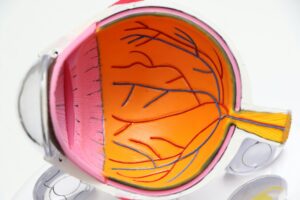
The mechanics are worth understanding because they are genuinely counterintuitive. The retina, in a healthy eye, contains roughly 120 million photoreceptor cells. Geographic atrophy destroys the central ones, but it typically leaves the downstream retinal neurons, the bipolar and ganglion cells, partially intact. Those cells are still wired to the brain. They are waiting for a signal that no longer arrives.
PRIMA steps into that gap. The implant’s photodiode array receives the near-infrared projection from the AR glasses, converts it to electrical current, and pulses the surviving downstream neurons directly. The visual cortex receives something it can work with. Over time, it appears to adapt, learning to interpret the coarser, lower-resolution signal the chip delivers as meaningful visual information.
The resolution is not HD. It is not even close. But for reading numbers, recognizing faces, and navigating the central field of vision, it appears to be enough. The brain, it turns out, is a remarkably forgiving decoder.
What Comes Next

Science Corporation’s regulatory submissions mean the question is no longer whether PRIMA works; he trial answered that, but how quickly approvals move and what the real-world rollout looks like. European and American regulators operate on different timelines and different evidentiary standards. A trial across 17 centers in five European countries carries weight. Whether it carries sufficient weight for approval in the near term is a different question.
There is also the question of access. A surgically implanted subretinal chip paired with custom AR glasses is not going to be cheap or simple to deploy. The 5 million people living with geographic atrophy are not evenly distributed across healthcare systems with equal surgical capacity. The gap between “this works in a trial” and “this is available to the person who needs it” has swallowed a lot of promising medicine.
But the PRIMAvera results do something specific and important: they move geographic atrophy off the list of conditions for which no vision-restoring intervention exists. That is nothing. For three decades, the standard answer to “Can I get my central vision back?” was no. The answer is now more complicated than that. Which, in medicine, is usually where progress begins.
The chip is thinner than a hair. The question it just answered took 30 years to reach.
This article was researched, written, and edited by our human editorial team. AI tools were used in a limited research-assistant capacity. All claims were independently verified.