

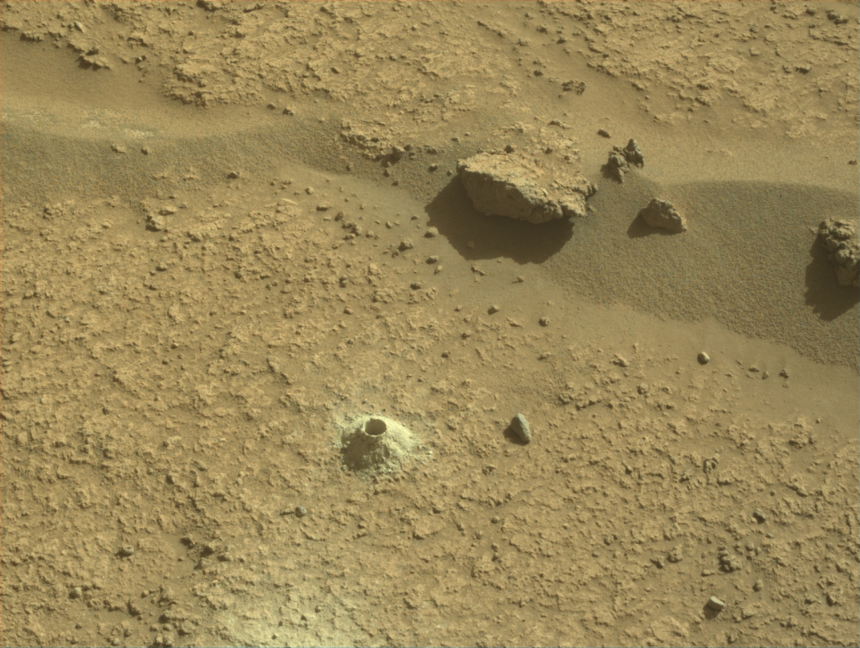
In October 2020, NASA’s Curiosity rover drilled into a patch of clay-rich rock on the slopes of Mount Sharp, inside Gale Crater, and extracted a sample smaller than a pencil eraser. The team called it “Mary Anning 3”. Then the sample sat sealed inside one of Curiosity’s onboard instruments while scientists waited, planned, and used up one of the two small cups of a reactive chemical called TMAH that the rover had been carrying since it left Earth in 2011.
That experiment had never been done on another planet before. Not once.
In April 2026, NASA’s Jet Propulsion Laboratory and a research team led by Dr. Amy Williams published findings in a peer-reviewed journal. The result: dozens of carbon-containing organic molecules identified in a single Martian rock sample. Several of them had never been detected on Mars before. And one had a structure similar to nitrogen heterocycles, compounds involved in building the rungs of DNA, never previously found anywhere on the planet.
Here’s the thing most coverage gets wrong about this finding: it doesn’t prove life ever existed on Mars. What it proves is something almost as striking. The raw chemical ingredients that life uses, on Earth, anyway, can survive on Mars for billions of years without being destroyed. That’s a different claim. And in some ways, a more durable one.
What TMAH Changes
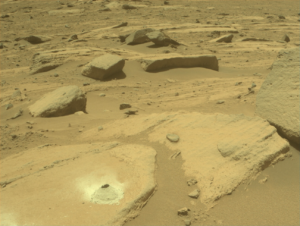
The TMAH wet chemistry experiment works like a molecular key. Most organic compounds on Mars are locked inside minerals, bound up in ways that standard instruments can’t reach. TMAH breaks those bonds. It frees molecules that would otherwise stay invisible, which is why Curiosity’s scientists saved it for exactly the right moment, and why the team used one of a small number of cups the rover carried.
The result is the most chemically detailed snapshot of ancient Martian rock ever recorded. Before this experiment, researchers could detect organic molecules on Mars, but the palette was limited. Now it has 21 entries, seven of them new to the catalog. The nitrogen heterocycle analog, the molecule with structural similarities to DNA’s building blocks, is the one that will keep astrobiologists busy for years.
Nitrogen heterocycles on Earth don’t just appear at random. They show up in living things, in the chemistry of life’s origin, and in certain meteorites that have traveled through space. Finding a compound with that structural fingerprint in a 3.5-billion-year-old Martian rock does not mean ancient microbes were there. What it means is that the chemistry capable of producing life, or produced by life, was present, and survived.
A Rock That Remembers
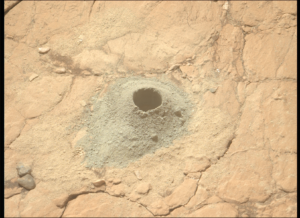
The Mary Anning 3 sample came from a clay-bearing layer of Mount Sharp that formed when liquid water still moved across Mars. Clay minerals are among the best preservers of organic chemistry in nature. On Earth, they can lock in biological signatures for hundreds of millions of years. The fact that Curiosity’s team chose this location wasn’t luck. It was a calculated bet.
The bet paid off. Twenty-one molecules. One planetary first. And a sample collected six years before the results were published, which is itself a small reminder of how science actually works, slowly, carefully, with instruments loaded onto rockets and aimed at a target 140 million miles away.
What Comes Next
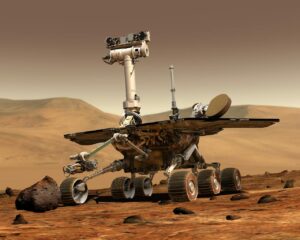
Curiosity still has at least one cup of TMAH remaining. The rover is now in its fourteenth year of operation on a planet it was designed to explore for two. At some point, the wheel drives will fail, the power will drop, and the last transmission will come through. But the science from Mary Anning 3 won’t close with the rover.
The findings sharpen the target for NASA’s Perseverance rover, which is collecting samples in a different Martian region for eventual return to Earth. When those samples arrive, assuming the mission holds, scientists will be able to run experiments impossible to fit inside a rover. The full range of organic chemistry that early Mars was capable of producing may be only a sample-return mission away.
For now, the Mary Anning 3 results stand on their own. A rock that formed when Earth’s continents were barely sketched in, sealed in Martian clay for 3.5 billion years, unlocked by a chemical tool that had never been used off-world. And inside it: the molecular architecture that, on one small planet circling a yellow star, eventually became life.
Whether Mars ever got that far is still an open question. But it had the ingredients.
This article was researched, written, and edited by our human editorial team. AI tools were used in a limited research-assistant capacity. All claims were independently verified.