

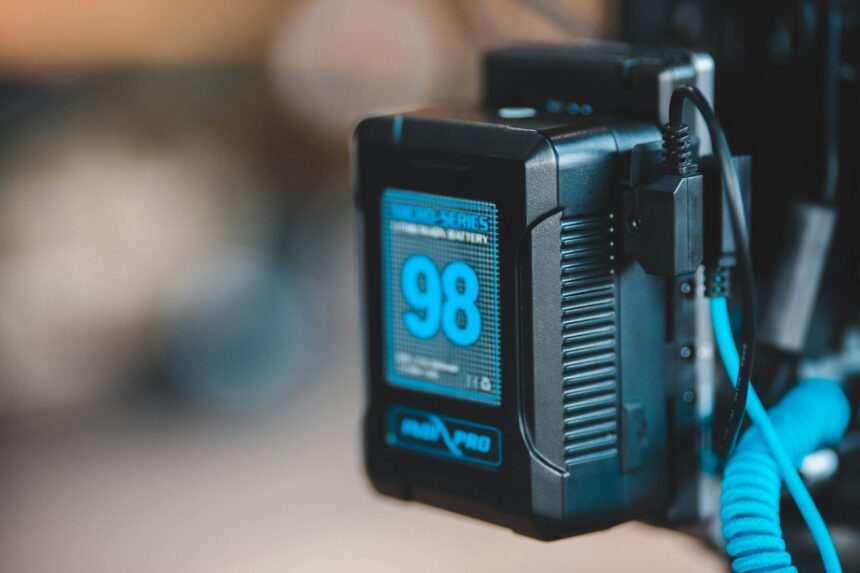
The battery in your phone needs a charger. The battery in your car needs a charger. Every battery you’ve ever owned needed something: a cable, a panel, a generator, or a wall. That assumption is now being dismantled, quietly, in laboratories at places like MIT and the University of Massachusetts Amherst, where researchers have spent years asking a question that sounds almost too simple: what if the air itself were the power source?
Turns out, it can be. And the implications are stranger and more significant than most people realize.
The science here is not science fiction. Air contains water vapor, and water vapor carries an electrical charge differential when it moves through certain materials at the nanoscale. Researchers at UMass Amherst, led by electrical engineer Jun Yao, demonstrated in work published in the journal Advanced Materials that a device made from a thin film of protein nanowires harvested from the bacterium Geobacter sulfurreducens could generate a continuous, small but measurable electrical current from ambient humidity alone.
No sunlight required. No mechanical movement. Just air passing through pores smaller than 100 nanometers, creating a moisture gradient that drives a sustained charge.
And here’s the strange part: the device works in the dark, indoors, underground, and in conditions where solar panels are useless. That’s not a minor footnote. That’s the entire argument.
Why Every Other “Free Energy” Device Failed This Test
The history of ambient energy harvesting is littered with devices that work in a lab and nowhere else. Thermoelectric generators need a temperature difference. Piezoelectric harvesters need vibration. Solar cells need photons. What Yao’s team and subsequent researchers found was something different, a material property that responds to a gradient that exists virtually everywhere on Earth, at all times, in all seasons. Humidity doesn’t switch off at night. It doesn’t require wind, heat, or mechanical stress. In most inhabited environments, relative humidity sits between 40% and 80% year-round.
The output of early prototypes was small. Milliwatts, not watts. But small is exactly the point. The Internet of Things already runs on devices that sip power rather than gulp it, environmental sensors, medical implants, remote agricultural monitors, structural health sensors embedded in bridges and pipelines.
These devices often sit in locations where replacing a battery is expensive, dangerous, or effectively impossible. A self-sustaining power source that asks nothing of the grid is not a curiosity for those use cases. It’s the answer to a real problem.
The Material That Made It Possible
The protein nanowires in Yao’s original device came from a specific microorganism, which created an obvious scaling problem. But later research, including work published in 2023, showed that the underlying principle generalizes.
The key is the nanopore structure, not the specific biological material. Thin films made from wood cellulose, carbon nanotubes, and other engineered materials have demonstrated the same moisture-gradient effect. The biological origin was a proof of concept. The concept proved.
What makes this architecturally interesting is the size. These films are measured in micrometers thick. They can, in theory, be printed onto flexible substrates, embedded in textiles, or layered under the surface of everyday objects.
A sensor-equipped bandage that never needs a battery. A structural monitor sealed into a concrete pillar at the time of construction, powered by the humid air inside the structure, forever. The math here gets speculative fast, and real-world deployment remains a genuine engineering challenge. But the physical principle is solid.
What It Can’t Do, Yet
Nobody is powering a refrigerator this way. The current outputs from demonstrated devices remain in the microwatt-to-milliwatt range, and stacking multiple layers to increase output introduces engineering complexity that researchers are still working through.
Scaling from a lab film the size of a postage stamp to a device that could charge a smartphone involves problems that haven’t been solved. The field is also young enough that long-term stability data, on how these films perform after years of continuous operation,n are limited.
But the trajectory matters. Solar cells in 1954 converted about 6% of sunlight to electricity. The comparison isn’t perfect, but the pattern is familiar: a proof of principle that seems too small to matter, followed by decades of materials science that makes it matter enormously.
The more honest framing is this: ambient moisture harvesting probably won’t replace your wall outlet. But for the billions of small, distributed sensors and devices that modern infrastructure increasingly depends on, a power source that requires no maintenance, no replacement, and no connection to anything is not a luxury. It’s a design goal that suddenly has a credible path.
Which sounds like a modest claim until you count the sensors. There are already billions of low-power connected devices deployed worldwide, and estimates for the coming decade put that number in the hundreds of billions. Every one of them needs power from somewhere. The air is everywhere. The math on that is worth doing.
If the real obstacle to a world of self-powered sensors was always the battery, and it was, then the question worth sitting with is: what gets built once the battery stops being the obstacle?
This article was researched, written, and edited by our human editorial team. AI tools were used in a limited research-assistant capacity. All claims were independently verified.