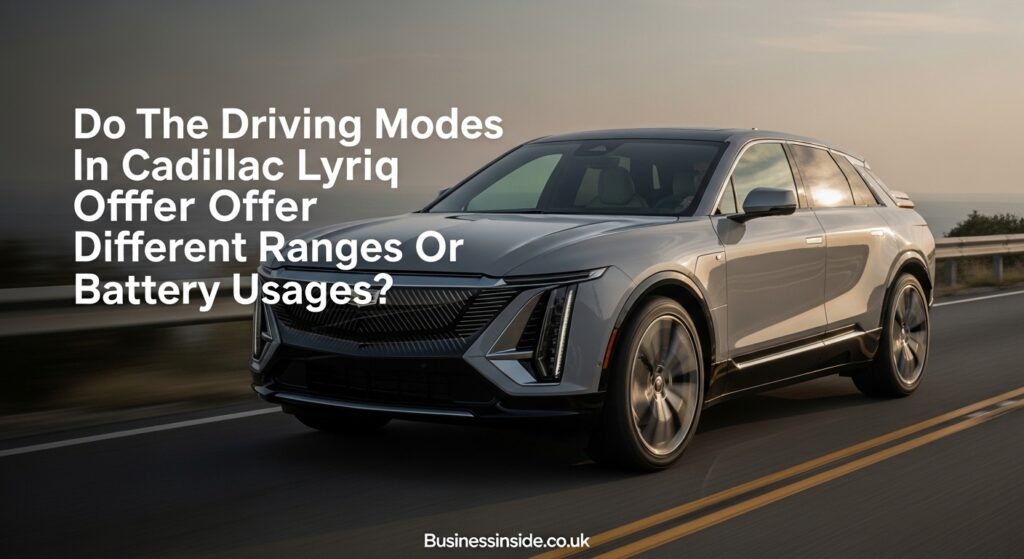

The Cadillac Lyriq has quickly become one of the most talked-about electric SUVs, offering luxury, advanced technology, and impressive range. But many drivers wonder: Do the driving modes in the Lyriq actually change its range or how the battery is used? Understanding how Tour, Sport, Snow/Ice, and My Mode influence energy consumption is crucial for maximizing efficiency, extending real-world range, and enjoying the full potential of this electric luxury SUV. In this article, we explore how each driving mode affects battery usage, what impacts real-world range, and how drivers can make informed choices to get the most out of every charge.
What the Cadillac Lyriq Is and Why Driving Modes Matter
The Cadillac Lyriq represents a leap into the future for the brand, marking Cadillac’s first fully electric SUV built on GM’s Ultium platform. As more drivers embrace electric vehicles (EVs), one question frequently arises: Do different driving modes in an EV like the Lyriq change the range or how the battery is used? To answer this meaningfully, it’s important to understand the relationship between vehicle systems, energy consumption, real‑world range, and driver behavior. Unlike traditional gasoline cars, where modes mainly adjust throttle and steering feel, EVs use modes that influence electric power delivery, regenerative braking, and efficiency systems — all of which can directly affect how far the vehicle travels on a given charge.
Electric vehicles charge energy into a large battery pack measured in kilowatt‑hours (kWh). The Cadillac Lyriq uses a 102‑kWh battery that holds the electrical energy used to power the motors. This stored energy does not change with driving modes; however, how that energy is consumed or conserved does vary based on the mode you select. That is why understanding what each driving mode does — in terms of power delivery, efficiency tuning, and regenerative systems — becomes essential for drivers who want to get the most out of every charge. Driving mode terminology like Tour, Sport, Snow/Ice, and My Mode are more than cosmetic settings; they represent distinct approaches to how the Lyriq manages its electric systems, which directly influences battery usage and real‑world range.
Driving modes can change characteristics such as throttle responsiveness, acceleration aggression, steering feel, regenerative braking strength, and even traction control behavior. Because an electric motor responds instantly and can regenerate energy back into the battery when decelerating, the interplay of these systems shapes how efficiently energy is used. For example, sharper throttle and reduced regenerative braking often increase energy consumption, whereas smoother throttle and stronger regenerative braking can conserve energy and extend range. Therefore, understanding how driving modes influence these systems is key to understanding how battery usage varies.
How Driving Modes Affect Battery Usage and Range in EVs
At the core of the question — whether driving modes affect range or battery usage — is the difference between static capacity and dynamic consumption. The static capacity is the fixed amount of energy stored in the battery, which in the case of the Lyriq remains the same regardless of mode. What changes is how that energy is consumed under different driving conditions and driving mode settings. Driving modes do not increase the physical size of the battery, but they can influence the vehicle’s energy efficiency. Energy efficiency is what determines how many miles you get out of that same amount of stored electricity.
Driving modes are essentially software calibrations that control key operating systems within the Lyriq. For example, throttle mapping determines how quickly and aggressively power is delivered when you press the accelerator. In modes geared toward performance, throttle mapping will prioritize immediate, strong motor output — something that generally increases energy consumption because the motor draws a higher energy current. Conversely, modes designed for efficiency use softer throttle mapping and smoother power delivery to reduce instantaneous energy draw. Regenerative braking — which captures kinetic energy during deceleration and returns it to the battery — also varies by mode. A stronger regenerative braking setting can increase energy recovery and slightly extend range by reducing the need for external braking energy losses.
These adjustments matter because electric cars do not have a “gearbox” in the traditional sense, and instead rely on motor efficiency and regenerative energy to maximize range. Every change made through a driving mode alters the balance between performance and efficiency. In real‑world conditions, an SUV like the Lyriq might achieve an EPA‑estimated range of more than 300 miles when driven under balanced conditions in an economy mode. Under more aggressive modes or performance‑oriented driving, that real‑world range can be noticeably lower due to increased energy demand. Hence, driving modes indirectly influence how the battery is used and how far the vehicle can travel before needing to recharge.
Tour Mode: Balanced Efficiency and Daily Driving
Tour Mode in the Cadillac Lyriq is generally considered the default or most balanced driving mode. It prioritizes smooth, predictable power delivery with a focus on energy efficiency, which makes it ideal for everyday driving conditions and highway cruising. When Lyriq drivers select Tour Mode, the SUV adjusts throttle response to be moderate, so that sudden accelerations are minimized and power is supplied evenly. This not only promotes better battery usage but also enhances comfort and stability, making it a practical selection for most driving scenarios.
Another important aspect of Tour Mode is its approach to regenerative braking. In electric vehicles, regenerative braking can slow the vehicle while capturing energy that would otherwise be lost as heat. This energy is then sent back into the battery, providing a small but meaningful efficiency gain. In Tour Mode, regenerative braking is calibrated to offer a balance between capturing energy and maintaining a natural, car‑like braking feel. The result is a smoother driving experience that captures energy efficiently without feeling abrupt or unfamiliar to drivers transitioning from internal combustion vehicles.
The overall effect of these calibrated systems within Tour Mode is an energy usage pattern that often results in higher real‑world range relative to more performance‑focused modes. Because the SUV is not demanding high instantaneous power from the battery and is recapturing energy through regenerative systems effectively, the total energy consumed per mile tends to be lower. Many Cadillac Lyriq owners find that Tour Mode helps meet or come close to the EPA‑estimated range in everyday driving, especially when combined with moderate driving habits and stable weather conditions.
Sport Mode: Performance Focus and Higher Consumption
Sport Mode offers a stark contrast to Tour Mode by prioritizing dynamic driving performance over efficiency. In this setting, the Lyriq’s throttle response becomes significantly sharper, offering quicker acceleration and more immediate power delivery when the driver presses the pedal. This can be exciting for drivers who want a more engaging driving experience or need quick acceleration for highway merging or overtaking. However, that stronger and more responsive throttle mapping typically increases instantaneous energy demand from the battery.
A performance orientation like that found in Sport Mode affects energy consumption for several reasons. First, aggressive acceleration — even over short periods — uses a disproportionate amount of electrical energy compared to smooth, gradual acceleration. Second, performance tuning often reduces the strength of regenerative braking or adjusts other systems in ways that favor driving feel over energy recovery. While Sport Mode does not change the total stored energy in the battery, it changes how quickly that energy is drawn upon, often resulting in higher consumption per mile.
Consequently, many drivers find that Sport Mode produces a noticeably lower real‑world range compared to Tour Mode, especially when driven aggressively. The trade‑off for more spirited driving is a larger battery draw, which means more frequent charging and a reduction in total miles per charge. For drivers who are focused on maximizing range or who undertake long trips, frequent use of Sport Mode can significantly increase the energy cost of travel and reduce overall battery efficiency.
Snow/Ice Mode: Safety in Slippery Conditions with Efficiency Considerations
The Snow/Ice Mode in the Cadillac Lyriq serves a different purpose compared to Tour or Sport modes: it enhances traction and stability when driving on slippery roads. In conditions like heavy snow, ice, or wet pavement, traction becomes a priority over outright efficiency. Snow/Ice Mode adjusts throttle response to be softer and less abrupt, which reduces wheel spin and increases control. Steering input and traction control systems are tuned to retain grip, making the vehicle more stable and predictable in low‑friction environments.
Because this mode focuses on maintaining traction rather than optimizing efficiency, it can affect energy consumption in subtle ways. A softer throttle response and traction system that intervenes more readily can result in energy usage patterns that are somewhat higher than in Tour Mode, particularly if the driving surface causes frequent wheel slip or if the vehicle continually corrects for instability. Snow/Ice Mode typically does not use significantly more energy than Tour Mode, but the difference becomes more noticeable when roads are slick and drivers are making frequent adjustments to maintain control.
Moreover, cold weather itself impacts battery performance, independent of driving mode. Batteries are chemical systems that operate less efficiently in cold conditions, and as a result, thermal management systems need to work harder to keep the battery within an optimal temperature range. This means that even in Snow/Ice Mode, part of the reduced energy efficiency can be attributed to temperature effects, not just the driving mode settings. The result is often a lower real‑world range in winter conditions, regardless of mode, though Snow/Ice Mode enhances safety during those conditions.
My Mode and Customization of Driving Feel and Efficiency
The My Mode feature allows drivers to create a personalized driving experience that sits somewhere between the preset modes like Tour and Sport. With My Mode, drivers can adjust throttle sensitivity, steering weight, regenerative braking strength, and even traction control behavior based on personal preferences. Instead of a one‑size‑fits‑all mode, My Mode empowers drivers to choose the balance they want between performance and efficiency.
For drivers who want to lean toward efficiency, it’s possible to set My Mode with softer throttle response and stronger regenerative braking. This configuration can emulate many of the range‑friendly characteristics of Tour Mode while still reflecting individual comfort and feel preferences. Conversely, if a driver prefers a sportier feel, My Mode can be tuned to mimic the responsiveness of Sport Mode, albeit at the cost of higher energy demand and reduced real‑world range.
Because My Mode is customizable, its impact on battery usage depends entirely on the settings chosen. It does not inherently increase or decrease range by itself; rather, it reflects the driver’s chosen balance. This level of personalization can be particularly valuable for drivers who want specific feedback from their vehicle systems without committing fully to the extremes of Tour or Sport settings. In practice, My Mode becomes a flexible tool for balancing comfort, performance, and efficiency based on real‑world driving needs.
Real‑World Range vs. EPA Estimates in the Lyriq
Electric vehicles, including the Cadillac Lyriq, come with EPA‑estimated ranges that are generated through standardized testing procedures meant to simulate typical driving conditions. For the Lyriq, these figures are often more than 300 miles on a full charge under balanced driving conditions. However, real‑world range can vary widely based on factors such as driving mode, speed, weather, terrain, tire condition, and use of climate control systems.
EPA testing assumes a mix of urban and highway driving, moderate temperatures, and relatively steady speeds. In everyday life, conditions are rarely identical to such controlled testing environments. Highways often require sustained higher power usage, which increases energy consumption. Cold weather can decrease effective battery output and necessitate greater use of cabin heating systems, which draws additional energy from the battery. Likewise, heat and aggressive driving patterns can also reduce achievable miles per charge.
Driving modes further shape how closely the real‑world range aligns with EPA estimates. Modes that emphasize efficiency — like Tour Mode or a well‑tuned My Mode — tend to produce range figures closer to EPA estimates under moderate conditions. In contrast, modes like Sport Mode or heavy use of Snow/Ice Mode in challenging conditions can lower real‑world range compared to EPA figures. The result is that the same Lyriq can return widely varying range figures depending on how and where it is driven, highlighting the importance of driving behavior and environmental factors in addition to driving mode selection.
Tips for Maximizing Battery Efficiency and Range in the Lyriq
To maximize battery efficiency in the Cadillac Lyriq, drivers should consider how driving mode integrates with other factors like speed, acceleration habits, and environmental conditions. Prioritizing smoother, more gradual acceleration in modes like Tour or a customized My Mode helps reduce instantaneous power draw, which preserves energy over longer trips. Regenerative braking should be used effectively to capture as much energy as possible, especially in urban stop‑and‑go traffic, where deceleration events are frequent.
Temperature management also plays a significant role. In colder climates, preconditioning the battery and cabin while plugged in can reduce the energy drain once driving begins. Minimizing the use of high‑energy systems like climate heating or cooling while driving can also improve range. Tire pressure, wheel alignment, and aerodynamic accessories further influence how efficiently the Lyriq travels; lower rolling resistance tires and proper inflation reduce energy losses.
Finally, recognizing that driving mode is one of many factors helps drivers make better charging and range planning decisions. Choosing energy‑focused modes on long trips and performance‑focused modes when efficiency is less important allows drivers to tailor battery usage to their needs. By combining thoughtful driving habits with intelligent mode selection, Lyriq owners can maximize how far they travel on each charge while still enjoying the benefits of a fully electric SUV.
Read More: Why UK Businesses Are Rethinking Their Social Media Strategy in 2026
Conclusion
The driving modes in the Cadillac Lyriq play a significant role in shaping how the vehicle uses its battery and how far it can travel on a single charge. While the battery capacity itself remains constant, modes like Tour, Sport, Snow/Ice, and My Mode adjust throttle response, regenerative braking, and traction systems, directly influencing energy consumption and real‑world range. Understanding these differences helps drivers balance performance, efficiency, and safety according to their driving needs. By choosing the right mode for the road conditions and driving style, Lyriq owners can maximize battery efficiency, enjoy a comfortable driving experience, and confidently make the most of this innovative electric SUV’s capabilities.